How a Dubai restaurant owner can boost online orders by 45% with a WhatsApp AI agent
Karim, owner of a Lebanese restaurant in Dubai, increased online orders by 45% in 4 months with a WhatsApp AI agent handling orders and bookings 24/7. Monthly ROI of 3,200 AED.
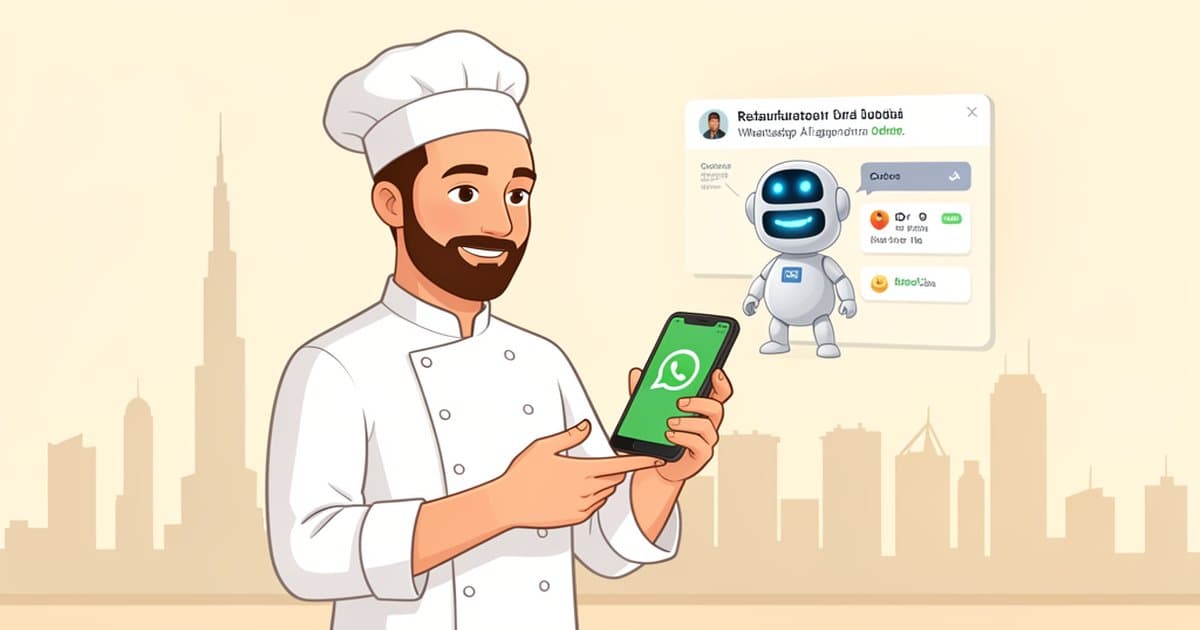
Dubai is one of the most competitive restaurant markets in the world. With over 13,000 restaurants for 3.5 million residents according to Dubai Tourism 2025, differentiation no longer rests solely on cuisine quality, but on availability and service fluidity, particularly for takeout orders and reservations.
Karim, owner of a Lebanese restaurant in Jumeirah, deployed a WhatsApp AI agent to handle orders and reservations 24/7. In four months, his online orders increased by 45%, for a monthly ROI of 3,200 AED (approximately 800 euros).
Why WhatsApp Over a Delivery App
Delivery platforms like Talabat or Deliveroo are essential in Dubai, but charge commissions of 25 to 35% on each order. For a restaurant with already-pressured margins, these commissions represent significant losses.
WhatsApp is the dominant communication channel in the UAE. According to the Dubai SME 2025 report, 68% of takeout orders in independent restaurants go through WhatsApp. Karim was already receiving orders on this channel but processing them manually, exposing him to errors and delays during peak times.
A WhatsApp AI agent lets him capture these orders directly, without platform commission, guaranteeing constant availability and responsiveness.
The Agent Architecture: 4 Blocks
Block 1: WhatsApp chatbot (Zapier + OpenAI API). Karim deployed a chatbot connected to the WhatsApp Business API via Zapier. The agent welcomes clients, presents the menu with photos, takes orders with modifications (no onion, sauce on the side, etc.), and confirms wait times. It responds in Arabic or English depending on the client's language.
Block 2: Reservation management. For table reservations, the agent presents available slots and confirms the booking in Google Calendar. For groups over 8, it triggers a notification to Karim for manual processing.
Block 3: Kitchen order transmission. Validated orders are automatically sent to an iPad in the kitchen via Airtable, displaying orders in real time with each client's specifications. The kitchen team no longer takes orders by phone.
Block 4: Follow-up and loyalty. After each order or reservation, the agent automatically sends a thank-you message. After 7 days, a personalized message with a loyalty offer. Karim found a 34% return rate among clients who received this message, versus 18% without follow-up.
Results After 4 Months
Before the AI agent, Karim processed an average of 45 WhatsApp orders per week, some lost due to slow response outside service hours. After four months, this rose to 65 weekly orders (44% increase), with 20% arriving between 10 PM and 8 AM, times previously uncovered.
Average order basket on WhatsApp is 12% higher than on Talabat, as the agent guides clients toward full meals and set menus.
Monthly ROI: 3,200 AED in additional revenue, for a system cost of 150 AED per month.
What This Model Teaches MENA SMBs
Dubai is an innovation laboratory for small businesses in the region. Practices emerging there, particularly intensive use of WhatsApp Business for commercial transactions, are spreading rapidly to Morocco, Saudi Arabia, Algeria, and other Arabic-speaking markets.
For French businesses active in MENA or looking to expand there, this type of AI agent represents a direct competitive advantage.
If you manage a restaurant or business in Dubai or the MENA region and want to automate your WhatsApp order taking, get in touch.
Frequently asked questions
Is WhatsApp the dominant channel for restaurant orders in Dubai?
Yes. According to the Dubai SME 2025 report on restaurant digitalization, 68% of takeout orders go through WhatsApp in independent restaurants in the UAE, versus 22% via delivery apps. This figure is even higher in Lebanese or Asian cuisine restaurants.
Can the AI agent handle orders in Arabic and English?
Yes. Current language models like Claude Sonnet 4.6 or GPT-5.5 Instant handle multilingualism seamlessly. Karim's agent automatically replies in the client's language, with equivalent quality in Arabic and English.
How does the AI agent send orders to the kitchen?
Orders validated by the AI agent are automatically transmitted via Zapier to a kitchen display screen (KDS) or printed on a connected thermal printer. Karim uses an iPad in the kitchen with Airtable consolidating orders in real time.
What happens if an item is out of stock?
Karim updates his Airtable menu manually every morning in 5 minutes. When an item is marked 'unavailable', the AI agent automatically removes it from proposals and suggests alternatives. This process can also be automated if stock is managed in a connected system.
Does the system handle allergen management?
The agent can display allergen information for each dish and filter proposals based on client dietary restrictions. Karim configured this feature after recurring requests from gluten and nut-allergic clients.