Why a successful AI pilot in one department almost never scales elsewhere
An AI pilot that works in sales guarantees nothing for customer service or production. Data and process silos explain why, long before budget does.
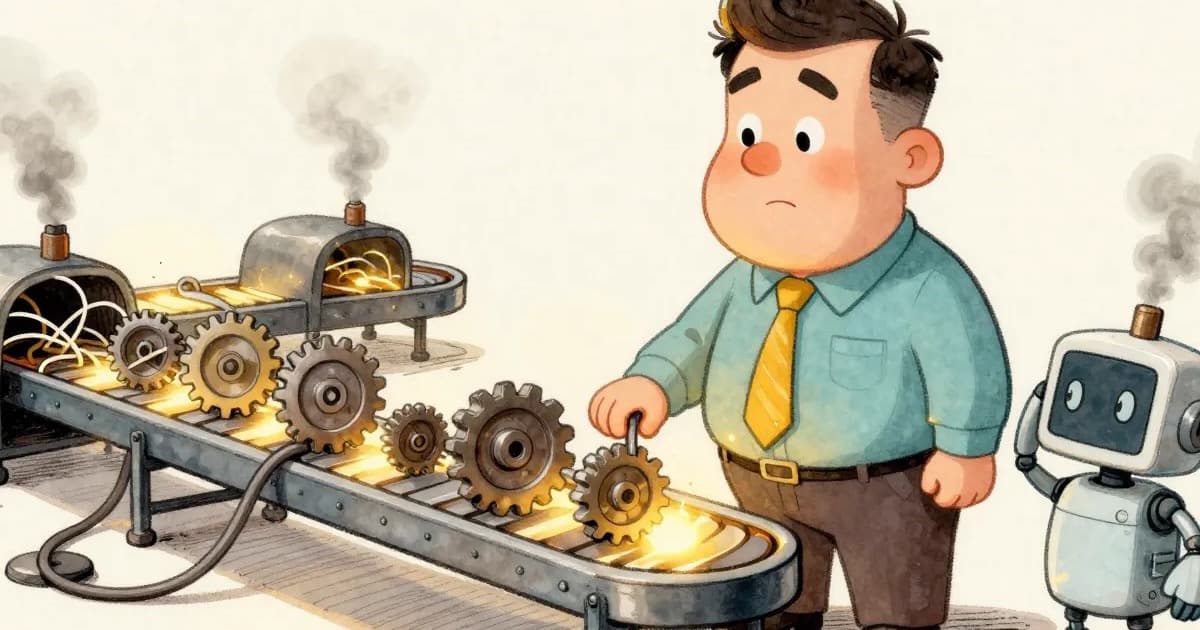
A successful AI pilot in one department says almost nothing about what will happen in the department next door. It is one of the most poorly anticipated realities for SMBs investing in a first AI project, and one of the costliest when it surfaces too late in the timeline.
The scenario repeats with striking regularity. One department, often sales or marketing, launches an AI pilot on a specific use case, lead qualification, meeting notes, customer feedback analysis. The data is clean, the process is already documented informally, and the user running the test is motivated and skilled. Results are good, sometimes excellent. Leadership naturally concludes that AI works for the company, and decides to roll the approach out to production, customer service, or HR. That is when the difficulties begin, and they almost never come from the tool itself.
The central problem is data silos. The department that succeeded with its pilot often had a structured CRM, a clean history, and enough volume for AI to produce reliable results. The department that then tries to reproduce that success frequently discovers its own data is scattered across several files, poorly labeled, or simply absent in a usable form. Reformatting that data before launching a comparable AI use case often takes longer than the initial pilot. This delay is not a project failure, it is a step the timeline simply never planned for.
A fellow consultant who advises mid-sized industrial companies recently shared a similar observation, an AI pilot for predictive maintenance succeeded on one production line in three weeks, but it did not scale to the other lines for eight months, not because of the technology, but because each line had its own sensors, its own log formats, and its own failure history. The pilot had proven technical feasibility. It had proven nothing about how repeatable the data preparation work would be.
This reality invites rethinking when the question of a scaling budget gets asked. Many companies wait until the end of the pilot to raise it, once results are in. That is too late. The question of reproducibility, what data is needed elsewhere, what process must be documented independently of the tool used, which department would be the natural second candidate, should be asked before the pilot even launches. A pilot designed from the start to be scalable costs barely more than an isolated one, and avoids an eight-month wait afterward.
There is also a less visible bias, that of the pilot user. The employee who tests an AI pilot is almost always a volunteer, curious and already comfortable with digital tools. This initial motivation hides part of the real change-management work that scaling will have to face, training teams that are less willing, who did not choose the project and who discover the tool without having tried it out of personal curiosity. A pilot run by someone moderately comfortable with digital tools, rather than the most enthusiastic person in the department, gives a more honest picture of what adoption at company scale will actually look like.
Scaling itself is better off not staying entirely in the hands of the pilot department. The team that succeeded knows the use case, but rarely the constraints of other departments. Cross-department coordination, led by general management or a designated AI lead, allows priorities to be arbitrated between departments with different needs, rather than mechanically replicating a solution designed for one specific context. For flows connecting several departments around one AI process, automation tools like Make.com avoid redeveloping each integration by hand, which meaningfully lowers the cost of that second wave.
This is exactly what the modeling step aims to anticipate, before the first pilot even launches: documenting the process independently of the chosen tool, and identifying from the start which data would be needed in other departments targeted for future scaling. A successful pilot remains good news, it proves that a specific use case works under specific conditions. It simply is not, on its own, proof that the entire company is ready to scale. A five-business-day diagnostic checks this reproducibility before you launch the next pilot.
Frequently asked questions
Why does a successful AI pilot in one department often fail elsewhere?
Because the pilot's success often depends on local conditions, clean data, an already documented process, a motivated user, that do not exist in other departments. The pilot proves AI works in a specific context, not that it works across the company.
What is the main obstacle to scaling a successful AI pilot?
Data silos top the list. A sales team with a clean CRM can get good results with AI, while a production team with data scattered across several files cannot reproduce that result without prior data structuring work.
How long does it typically take to scale a successful AI pilot?
There is no universal timeline, but field experience shows that preparing data and reformalizing processes in the second department often takes longer than the initial pilot itself.
Should a dedicated scaling budget exist before launching a pilot?
Not necessarily a pre-set figure, but a decision of principle. A pilot launched with no intention to scale remains an isolated IT project, useful for learning, but it changes nothing at the company scale.
Should the department that succeeded with its pilot lead the rollout to other departments?
Rarely in full. The pilot team brings usage experience, but scaling requires cross-department coordination, often led by general management or a designated AI lead, to arbitrate priorities between departments with different needs.
What signals distinguish a pilot that will scale from an isolated one?
Whether the data used is reproducible in other departments, whether the process is documented (not just the result), and whether at least one other department is involved from the pilot phase rather than afterward.
Can no-code automation help scale an AI pilot without heavy development?
Yes, for simpler cases. Tools like Make.com can connect several departments around a single AI workflow without rebuilding each integration by hand, which lowers the cost of the second wave of rollout.
Which step of an AI project prepares a pilot for scaling?
The Modeling step, before the pilot itself, should document the process independently of the tool and identify the data needed in other departments targeted for future scaling. Without this step, each department starts from zero.