Industrializing AI: do you need an internal team or a vendor to scale up?
After a successful PoC, the question of who leads industrialization rarely gets asked early enough. Neither all-internal nor all-outsourced suits every SMB. How to decide.
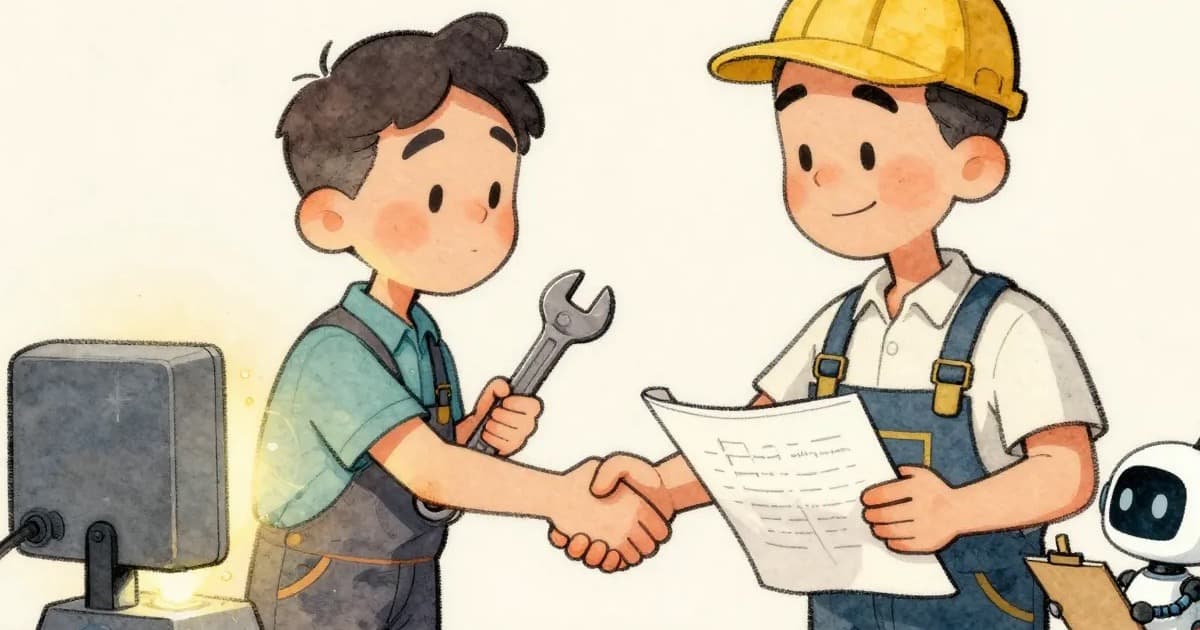
Once an AI pilot is judged successful, a governance question almost always surfaces too late, who will lead its industrialization. Neither hiring a dedicated internal team nor fully delegating to an external vendor is a satisfactory answer in the abstract, the right choice depends on the nature of the project, rarely on a matter of principle.
Hiring a full internal AI team remains a sound option for a limited number of SMBs, particularly those for whom artificial intelligence becomes a central strategic pillar of their future business, rather than just one productivity tool among others. For most ten-to-fifty-person SMBs, that level of hiring investment, at a time when AI skills rank among the hardest to fill on the market, is neither realistic nor justified by the volume of projects underway.
Handing the entire industrialization to an external vendor carries a different but equally real risk, lasting dependency. A company that fully delegates the technical execution of its project loses, in the same move, the ability to evolve it on its own. Every future adjustment, even minor, then requires going back through the original vendor, with cost and delay building up over the years, and a dependency that deepens as the project becomes more central to the business.
Conversely, handling the entire industrialization in-house with no external support exposes you to timeline and quality risk. A team learning AI industrialization on the job, with no comparable prior experience, typically takes two to three times longer than a vendor already seasoned in this kind of work, with a heightened risk of costly design mistakes to fix once the project is already deployed.
The split that works best in observed practice combines both approaches rather than pitting them against each other. An internal point person carries the business vision, knows the company's actual priorities and constraints, while an external vendor handles the more complex technical execution, with a skills transfer organized gradually from the project's launch, rather than negotiated under pressure once the vendor is already gone.
This skills transfer should not stay a vague intention stated at the end of an engagement. It is better formalized in the initial contract, as an explicit clause covering skills transfer and complete, usable technical documentation. This clause, often overlooked at signing, directly determines the company's ability to later take back control of its own project, or switch vendors, without starting from zero years down the line.
There is no universal company-size threshold beyond which an internal team automatically becomes worthwhile, the most determining variable remains the number of AI projects run in parallel rather than total headcount. An SMB managing a single AI project generally has no reason to bring a full-time dedicated team in-house, whatever its size otherwise. This choice, moreover, should not be settled once and for all at the company level, but decided project by project, based on the technical complexity and strategic weight specific to each initiative.
This is what the steering step establishes, defining who leads execution for each project and in what split between internal and external resources, based on the complexity identified during the prior diagnostic rather than by default. A five-business-day diagnostic recommends the split best suited to your project.
Frequently asked questions
Should an SMB hire an internal AI team to industrialize a project?
Rarely in full, unless AI becomes a major strategic pillar of the business. For most SMBs, a small internal team paired with a specialized vendor for complex technical phases offers a better cost-to-effectiveness ratio.
What are the risks of outsourcing industrialization entirely to a vendor?
The main risk is lasting dependency, the company loses the ability to evolve its project on its own, and every future adjustment requires going back through the vendor, with cost and delay accumulating over time.
What are the risks of handling everything in-house with no external support?
The main risk is timeline and quality, an internal team learning AI industrialization on the job typically takes two to three times longer than an experienced vendor, with a higher risk of costly design errors to fix after the fact.
What split of roles works best in practice?
An internal point person who carries the business vision, knows the company's priorities and constraints, paired with a vendor for the more complex technical execution, with a skills transfer organized gradually from the project's start.
How do you avoid excessive dependency on an external vendor?
By building, into the initial contract, an explicit skills-transfer clause and complete, usable technical documentation, which lets the company take back control or switch vendors without starting from scratch.
At what company size does an internal AI team become worthwhile?
There is no universal threshold, but relevance grows with the number of AI projects run in parallel. A company managing a single AI project generally has no reason to bring a full-time dedicated team in-house.
Should the internal-versus-external choice be the same across all of a company's AI projects?
No, this choice should be decided project by project based on its technical complexity and strategic weight, rather than through a blanket policy applied uniformly across every project.
At which step of an AI project should this project-governance decision be made?
The Steering step defines who leads execution and in what split between internal and external resources, based on the complexity identified during the prior diagnostic.